
Beautiful things work better!
Perhaps because it reflects real life, but I’ve always been fascinated by the way different subject areas in school overlap. And my two years as a creative technology and design teacher sparked a love for STEAM projects. STEAM, if you are unfamiliar, refers to school assignments that integrate Science, Technology, Engineering, Art, and Math to differing degrees. The key is that it’s all connected. Most of us teachers have been teaching in our subject areas for so long, that we lose track of all the connections, but once you make a few, you begin to see the ways in which your subject area consistently makes connections to other learning areas (and that makes designing STEAM projects much easier).
When I lead workshops on STEAM, I ask my participants to write STEAM vertically on a paper and then brainstorm overlaps in each area. I also ask them to use an AI chatbot for brainstorming. Once you identify the overlaps, it’s easy, they reoccur in different ways. Your framework for teaching also matters. Many (but not all) of the STEAM projects I did were for middle school because I follow a framework based on International Baccalaureate’s MYP design and art cycles. Units start with and inquiry/analysis/investigation and end with an evaluation/reflection, and that’s where I can include questions about science, art, and math, as engineering and technology are almost always prevalent in design projects.
After going to a few STEAM presentations, I set a few rules for myself when designing these projects:
- Aesthetics: Does it look good? Does it provide students with sometime to bring home that they’re proud of?
- Accessibility: Is this some most schools could do without buying significant new resources?
- Practicality: Does it teach students an important life skill or is it completely niche?
- Subject area: Does it touch upon all 5 areas of STEAM in some way?
I would also add that it’s important to keep a journal. My students have an A3 (tabloid size) binder where they can keep their research, sketches, and evaluations all in one place. I found this to be more useful than a typical sketchbook or notebook in art as well as design classes. And I insist on handwriting. If you have an AI platform open, ask it about the educational benefits of handwriting. They are numerous, and profound.
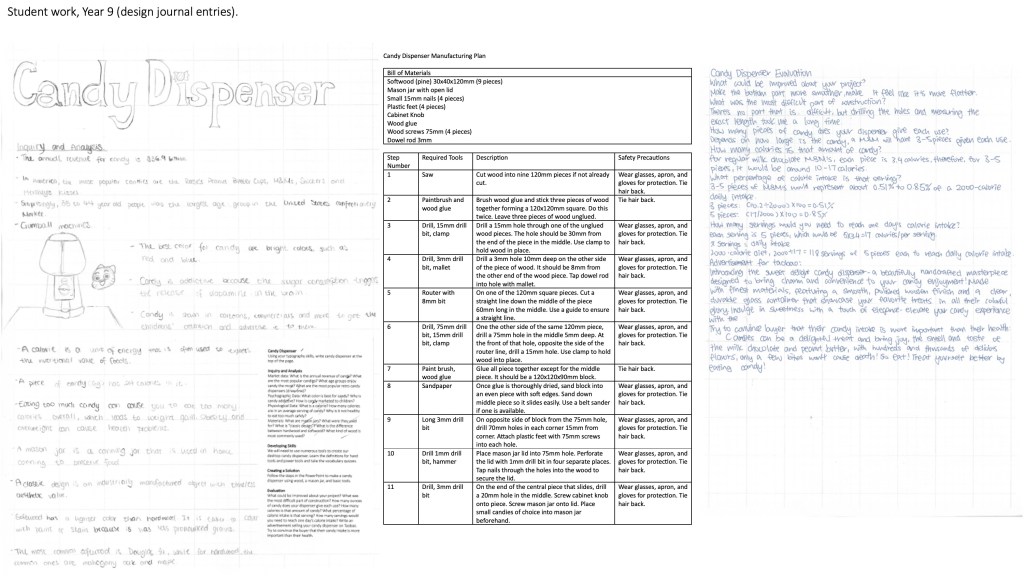
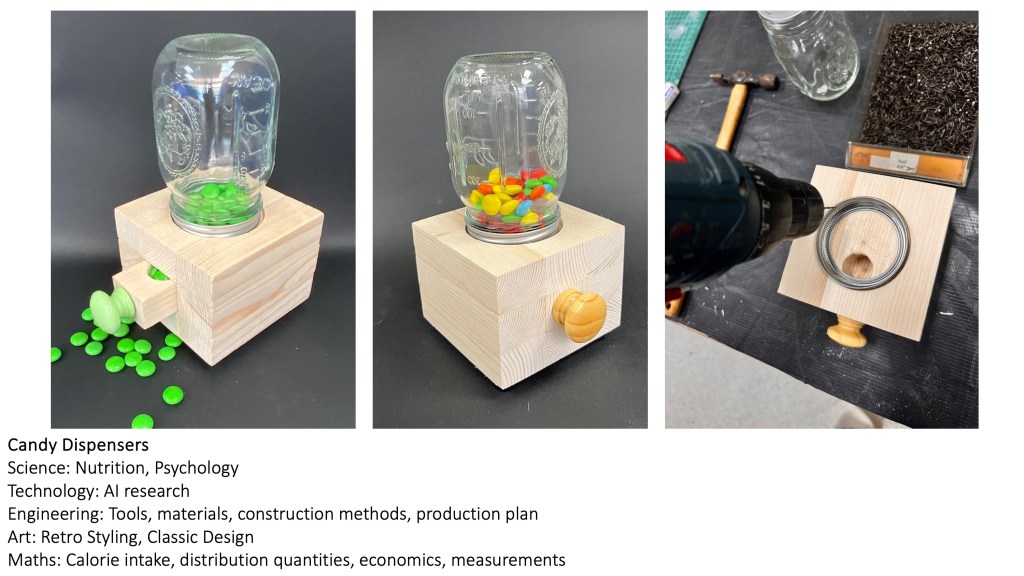
I’ll use the example of a project I did this year, a candy dispenser made with a mason jar. It would have been easy to just make it a simple wood shop project, but integrating questions about nutrition, color, and psychology (why do kids love candy and is it addictive?) didn’t require a lot of extra work and transformed the assignment into a STEAM project. The more you integrate these things, the easier it gets and the better you get at doing it. In the candy dispenser unit, I had an evaluation question at the end asking students to figure out how many times they would need to use their candy dispenser to survive for one day. A bit of an absurd question, but it required math and user testing to figure out! First they had to find out the daily calorie intake for someone their age, test how many pieces of candy came out per use on average from their dispenser, research the calorie amount in each serving based on what the candy was (jelly beans, skittles, m&ms, etc.), then divide that amount by the total calorie intake to get their answer. I would have never thought of that at the beginning of my STEAM journey, but now these questions come a lot more naturally.
I’ve attached an adaptation of the presentation I give about STEAM which has 11 project examples. Most of them have already been posted in this blog. Admittedly the slides aren’t that well-arranged (cluttered) as I’ve tried to include lots of resources on each image.
Link to my pdf of my STEAM projects.
 Draw, Paint, Think