

Artistic composition is a fundamental part of my pedagogy. Perhaps that’s because it was looked over for most my own art education and I had to painstakingly pick it up through intuition and osmosis. Admittedly, that’s what you want though…an informed but intuitive approach to art making. Anyway, I teach my kids about composition and give them a laundry list of rules (or considerations) to memorize. Is it too geeky or nit-noid though? I don’t think so. Even if you don’t make compositionally strong work afterwards, at least you should have a better vocabulary for unpackaging the artwork you see in galleries or museums.
The role of artistic composition is simple. It’s a methodical approach to the picture plane. Things get more complicated after that, however. Most teachers teach the rule or thirds (most cell phones also have it in their cameras); many teach negative space. But how many teach leading lines, breaking the picture plane, points of emphasis, or the Fibonacci Spiral? I’ll leave you with a list of compositional considerations (they’re not really rules) that I teach students. If you have any you would add to the list, please get in touch and tell me! I’ll also include a few screens from my presentation on the subject. If you want my resources on this, get in touch.
Compositional Considerations (my list)
Rule of Thirds: Dividing the composition vertically and horizontally into thirds and placing artistic elements on those lines. Triangular Compositions: When art elements are arranged in a triangular formation.
Diagonals and Movement: Diagonal arrangements of a composition imply movement.
Leading Lines: When art elements in a composition imply lines.
Breaking the Picture Plane: This refers to art elements going off the sides of the picture.
Negative Space: Refers to areas which are not the main subject matter and argues that they should also be interesting shapes.
Rhythms: These are similar shapes which change and often imply movement.
Patterns: Duplicated art elements.
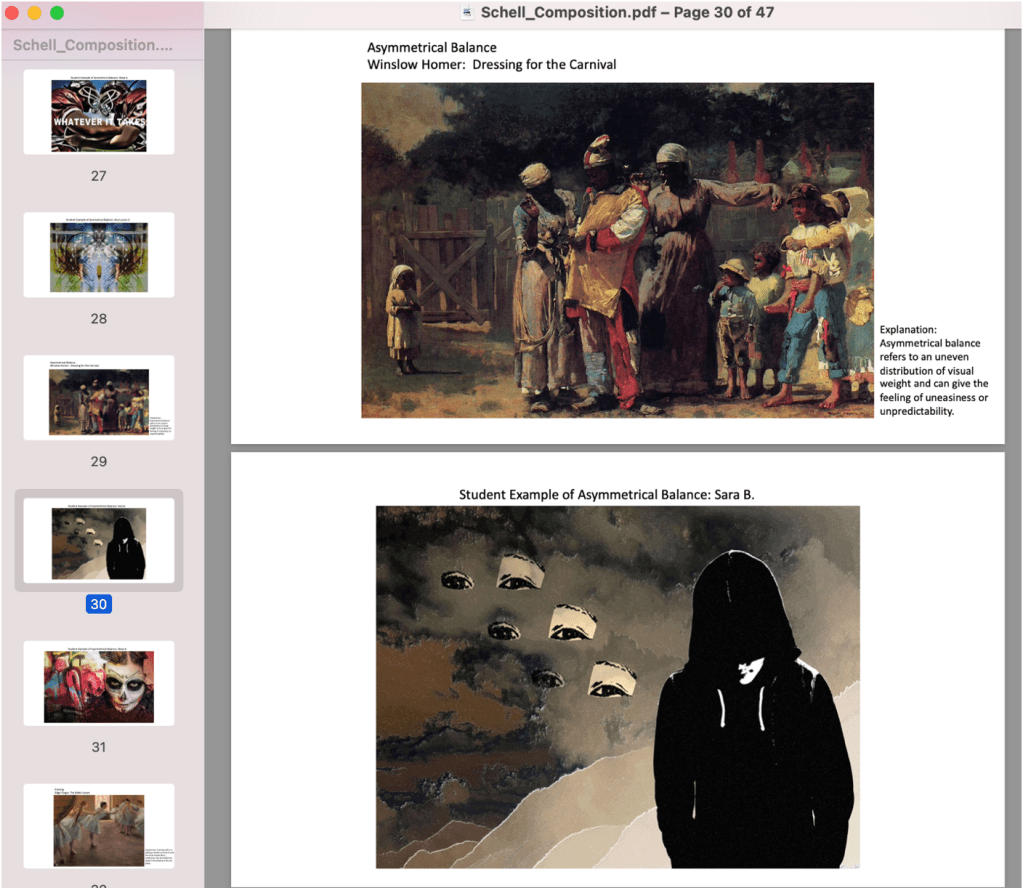
Symmetrical Balance: Refers to an equal distribution of “visual weight”. It can give a tranquil or harmonious feeling to art. Asymmetrical Balance: Refers to an uneven distribution of visual weight and can give the feeling of uneasiness or unpredictability.
Framing: Refers to placing a border around an area that the artist would like to emphasize.
Emphasis: Refers to knowing exactly where the artist wants you to look first when you see their work.
Figure Ground Relationship: Refers to the distinct relationship artists negotiate between the subject matter and the background.
Fibonacci Spiral: Invented in the 1200s, this was considered one of the most perfect ways to divide a picture compositionally.
 Draw, Paint, Think